
Inside PBL Future Labs
What we build and how to partner with our team.

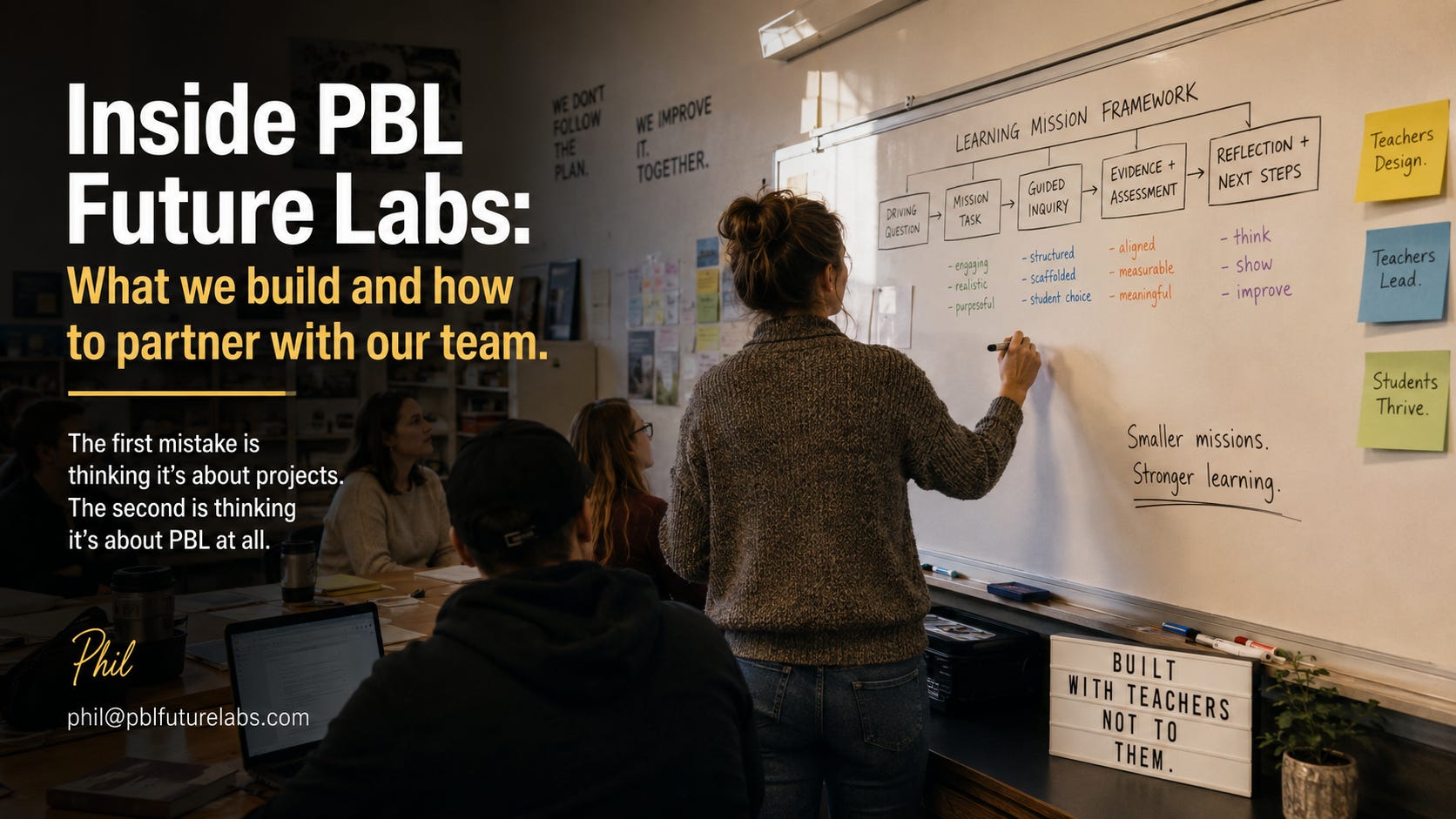
The first mistake is thinking it’s about projects. The second is thinking it’s about PBL at all.
People hear “PBL Future Labs” and picture the same thing every time. A class building something messy for six weeks. A “real-world” dessert project product task that ends in chaos and a parent complaining at pickup. Big projects, badly run.
My co-founder, Thom Markham, wrote one of the first books on project-based learning. I’ve read what came after it too, every blog post, every case study, every “PBL done right” framework for the last twenty years. None of it solved the problem I actually had standing in a classroom: how do you make this ‘rigorous’ (structured), understandable, and repeatable for a teacher who isn’t me, on a day when I’m not in the room? How can you align assessment? How do you know that the student has done any learning in their group today?
So I stopped arguing about PBL and with my own time, not with AI, built something past it, in my own classes, as a specialist, as a classroom teacher. Smaller missions instead of giant projects. When AI arrived, I used it to analyse and work out how the hell can you turn curriculum into a good project, that is guided, structured, without being chaos, without being a normal product based assessment. You should see the early versions of the Learning Mission Framework. 80 pages of research, complex as hell. I then had to simplify that into 2 pages. Language simple enough that the least confident teacher on staff can run it without us. A system someone else can run after we leave.
Forget whether project-based learning is good.
This industry has a standard answer to that. If you have the time to work it out, sure, but with low buy in, marketing pbl schools, low instructional leadership and highly stressed environments, it will never work. Write the book. Build the curriculum binder. Sell the PD day. Train the trainers. Move to the next district. It scales the seller. The day the consultant leaves, the binder goes in a cupboard and staff go back to what they knew before, because nobody on site actually owns the thing. It was handed to them.
We picked the slower answer. You start with the people already standing in the building.
That’s what Future and Labs are actually doing in the name. Future isn’t a marketing word, it means built for where teaching is heading, AI-fluent, not a framework frozen in 2007 with a “21st century skills” sticker on the front. Labs means what it sounds like in an actual research building: we test this with real schools and real classrooms, and the framework changes when the evidence says it should. It isn’t a finished product we shipped once. It’s something we’re still building, with the people using it.
Which gets to the ‘What is PBL Future Labs anyway?’ question. We’re not a consulting team that arrives and does PBL to a school. That model has an expiry date stitched into it from day one, the day the consultant leaves is the day the thing starts dying. We build staff agency: teachers who can design, run, and improve this kind of learning without one of us standing over their shoulder.
I want to highlight one staff member, at Choice Charter School in Iowa, the special education coordinator, Mindie Smith as someone who gets it. I look forward to hosting a PBL Future Labs podcast with her at some point. Mindie started by learning to set up an AI skill to build differentiation tools for neurodivergent students. A few many months in, she’s not waiting on us for the next step. She’s developing her own tools, testing them with kids, and getting ready to teach the rest of the special ed staff how to do the same. I ran a session on Claude skills, and the goal was for Mindie to create this herself, in her way, and I just helped with strategy.
Multiply that across a staff and the culture shifts. Teachers start running their own showcase events to other staff. They give each other feedback. They write their own protocols for consistency, some spend weekends working with AI to get clearer protocols. My job ‘on site’ moves from running everything to running a handful of targeted workshops for whoever needs the next piece. I’ve said this to staff and leadership directly: there isn’t one of them who doesn’t know more than I do about their own subject and their own kids. What I know is the pedagogical structure, and I can help bridge some key challenges that people have on a global scale.
PBL, and AI doesn’t land with everyone at once, and pretending otherwise would be dishonest. Some staff leave a school when AI and project-based learning show up at the same time, that’s a lot of change in one go, and walking away is a fair response to it. Collective effacacy is needed here, as the staff will bring up the other staff, any approach that isn’t collaborative will fail.
I heard the same pattern recently from Kenneth Oroma, who’s exploring this for a STEM pilot in Uganda through Learning Equality, a company I am going to work with. He described a different organisation’s rollout where the teachers everyone considered the best and most experienced were the first to reject the program outright. Strong arguments, too, their results were already good, so why change? Those same teachers ended up the ones who spread it across the region, once they’d watched it work rather than been told it would. The people who resist longest are usually the ones who carry it furthest, but only if they get there on their own terms instead of someone else’s binder.
So, what do we actually do at PBL Future Labs? We don’t sell a one size fits all program. We don’t sell a stack of books. We rebuild a school’s own capacity to design good learning, and we measure success by how fast we make ourselves unnecessary. That involves staged integration. We teach many frameworks, our learning mission framework, my ai with purpose CRAFT framework, PBL Gold Standard, 5E, Inquiry-Based, Design Thinking, Problem-Based Learning, that’s just scratching the surface, honestly teachers do a mix of frameworks in all their classes, it’s complex, but with reasoning.
Empower your staff, I can give you recommendations and testimonials from the schools I work with to see what this experience is like.
Phil